It's the question we get asked most before someone's first class, usually phrased like this: "but when will I actually be able to dance?". The short answer is sooner than you think to have fun, and later than you think to dance well. Here are the realistic timelines.
After your first class
You leave knowing the basic step and, with luck, a simple turn. You're not dancing "well", but you can follow a slow song without getting completely lost.
The important part of that first session isn't technical: it's discovering that nobody is watching you, that everyone makes mistakes, and that people who've been dancing a year still step on their partner's toes now and then.
After a month (4-5 classes)
This is where the jump happens that gets people hooked. After four or five sessions, most people can:
- Hold the beat without counting out loud.
- Lead or follow a basic turn comfortably.
- Dance a full song at a party without feeling exposed.
This is the moment to go to a party or a social. You feel awkward for five minutes and great for the next two hours.
After three months
You no longer think about the basic step; it just happens. You start hearing music differently, noticing when a song is about to change, and adapting to partners of different levels.
This is also when the first plateau shows up. It feels like being stuck, and it's actually the opposite: you're refining subtle things — weight, posture, leading — that don't show but that partners feel.
After six months to a year
You dance comfortably with anyone, you improvise, and you start developing your own style. By this point most people have gravitated towards a style, which we cover in bachata styles.
What makes some people progress twice as fast
It isn't talent. After many groups, the difference always comes down to the same things:
- Dancing with lots of different people. Partner rotation is the single biggest accelerator there is. Everyone leads differently, and that forces you to adapt instead of memorise.
- Going to socials early. One night of social dancing teaches more than three classes in a row, because there's no teacher correcting you and your body solves it on its own.
- Practising little and often. Five minutes of basic step in the kitchen with music on beats two hours on a Sunday.
- Not obsessing over figures. Dancing three things well is infinitely better than dancing fifteen off beat.
The fastest way to start in Málaga
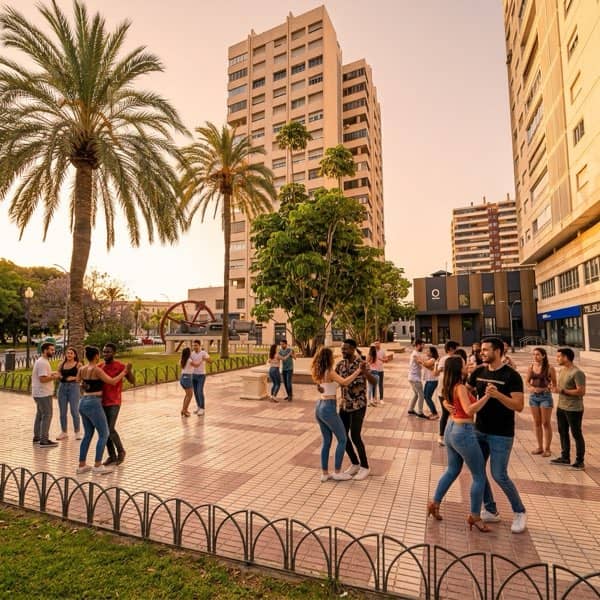
Our bachata classes in Málaga run outdoors next to the Steam Engine Sculpture, with partner rotation, for €10 per class. There's no enrolment fee and no commitment, so you can try a week and see how it feels.
Before you come, take a look at what to bring to your first class and the beginner's guide. And if you're coming without a partner, don't worry: that's the norm, as we explain in dancing bachata without a partner.